Step 1: Don't panic.
Step 2: Read this article to make sure your hard-earned (or VC 👀) money doesn't go to waste because you weren't prepared.
At Stella Startups, our team is well-accustomed to preparing early stage startups for conferences, often within a limited timeframe and budget.
As a startup, you're trying to "play with the big guys" and look like an established well-put-together operation, when in reality you're building the plane while flying it. This makes conference preparation challenging but that's all part of being a startup, right?
So if you find yourself with a conference booth spec sheet and an event organiser emailing you instructions but you have no clue what to do next, read on. We've got you covered.
1. Set your goals
Conferences can play a role in your marketing strategy, but one thing they're not is a fix-all.
Many founders will spend several thousand dollars on a conference package or sponsorship (sometimes more than they've ever spent on a single marketing activity) and have expectations of the event significantly changing the trajectory of their business. While we'd never rule out miracles, this is almost never the case. B2B teams that make conferences part of their strategy are usually attending many a year, with each making an incremental impact.
Depending on your business stage and product maturity, set conference goals that are ambitious, but realistic. Ideally keep it to 1-2 major goals so those attending from your team have a single-minded focus on what they're aiming to achieve.
For example:
- Build the brand perception among prospective customers that we are [insert brand perception here e.g. The simplest to use and most accurate carbon accounting software]
- Speak to 20 ICP-aligned customers and get their contact email for follow-up
- Find 5 potential partners for our product who will support our launch/roll-out
- Build our circle of influence with policy makers and industry bodies to shift the needle on [topic]
2. Decide what you want to say
Once you have your goals in mind, decide on your core messages for the conference. These should align with your broader brand positioning but be nuanced according to your specific audience (i.e. who will be attending) and your conference goals (see above).
If you've purchased booth space, you or your team will inevitably find yourself standing (somewhat awkwardly) as event attendees wander past, wondering whether or not to bother talking to you.
If they do approach they'll almost certainly ask something along the lines of "and what do you do?". In their heads they'll be thinking, "is this relevant to me?", "do I care about this enough to stay and chat?". If you don't have a plan for how you'll handle these interactions, you'll find yourself twiddling your thumbs in a very expensive 3x3m square of carpet for the majority of the conference.
How do you fix this? Prepare these things ahead of time:
- Get clear on your positioning strategy (there's a lot more to this but at it's simplest, know who your product is for and why)
- Decide on the potential "personas" that might approach your booth
- Craft your elevator pitch (and practice adapting it to the different personas)
- Agree on the top 1-2 calls-to-action you’ll use to get prospective customers’ details for post-conference follow ups (e.g. “join our waitlist/mailing list”).
- Craft a simple talk-track for anyone who will be at the booth during the conference so they have a go-to structure when chatting to attendees e.g.:
- Ask questions (understand persona)
- Elevator pitch
- Follow-up Q&A
- Call to action
- Provide collateral/takeaway
3. Prepare your signage
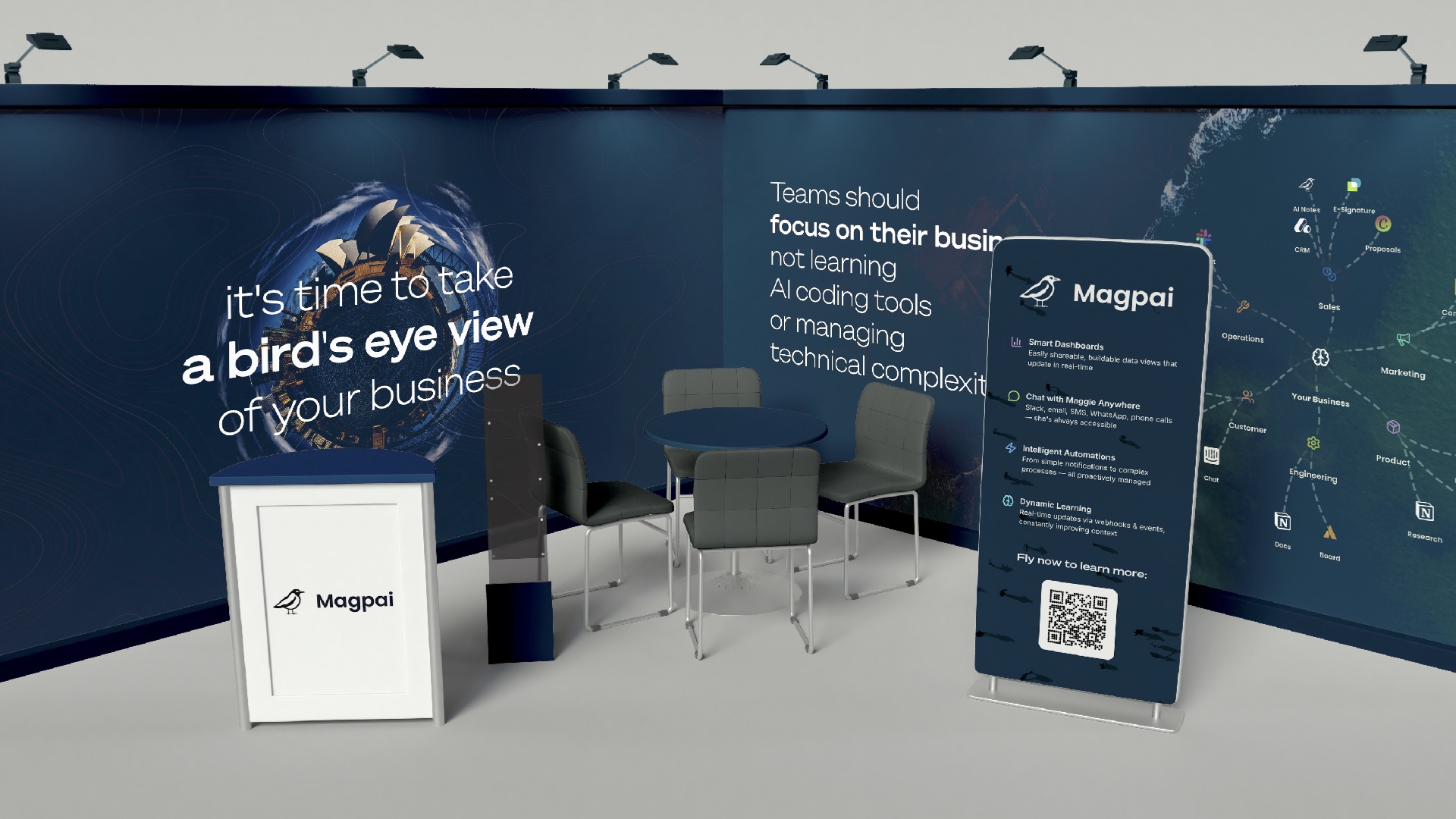
If you've bought booth space at a conference, you'll almost certainly need to organise some form of printed signage. For example, your booth walls or backdrop, pull-up banners and sometimes fancy things like branded furniture, hanging signage or interactive experiences.
Some conferences offer more support with signage than others and some have very specific requirements to follow. Ideally before you lock in your booth (and otherwise ASAP once you have), ask about these requirements so you understand what's included in the price of your package, what will be an additional cost and whether there are strict deadlines on supplying designs for approval or printing. These deadlines can be anywhere from 1-4 weeks ahead of the event date so do not wait to ask for this essential info. This is probably the biggest mistake we see startups make!
Print collateral of any kind can create a special kind of stress even for the most cool-headed founder so we highly recommend finding yourself a designer (and printing partner) with expertise in event signage. No matter how good you are at using Canva, if you're not a designer we don't recommend trying to DIY your designs for a booth you've already sunk thousands of dollars into.
Professional designers will not only make you look the part, they'll understand what the specs provided actually mean (think: crop marks, bleed and dpi), and ensure none of your design files are rejected at the final hour. Give your designer the specs at the start of working together along with a very clear brief on what you want. More experienced designers will be able to come up with a creative approach to the booth as a whole and help execute the designs, whereas less experienced designers will need you to be more explicit, using your brand guidelines to create the final product.
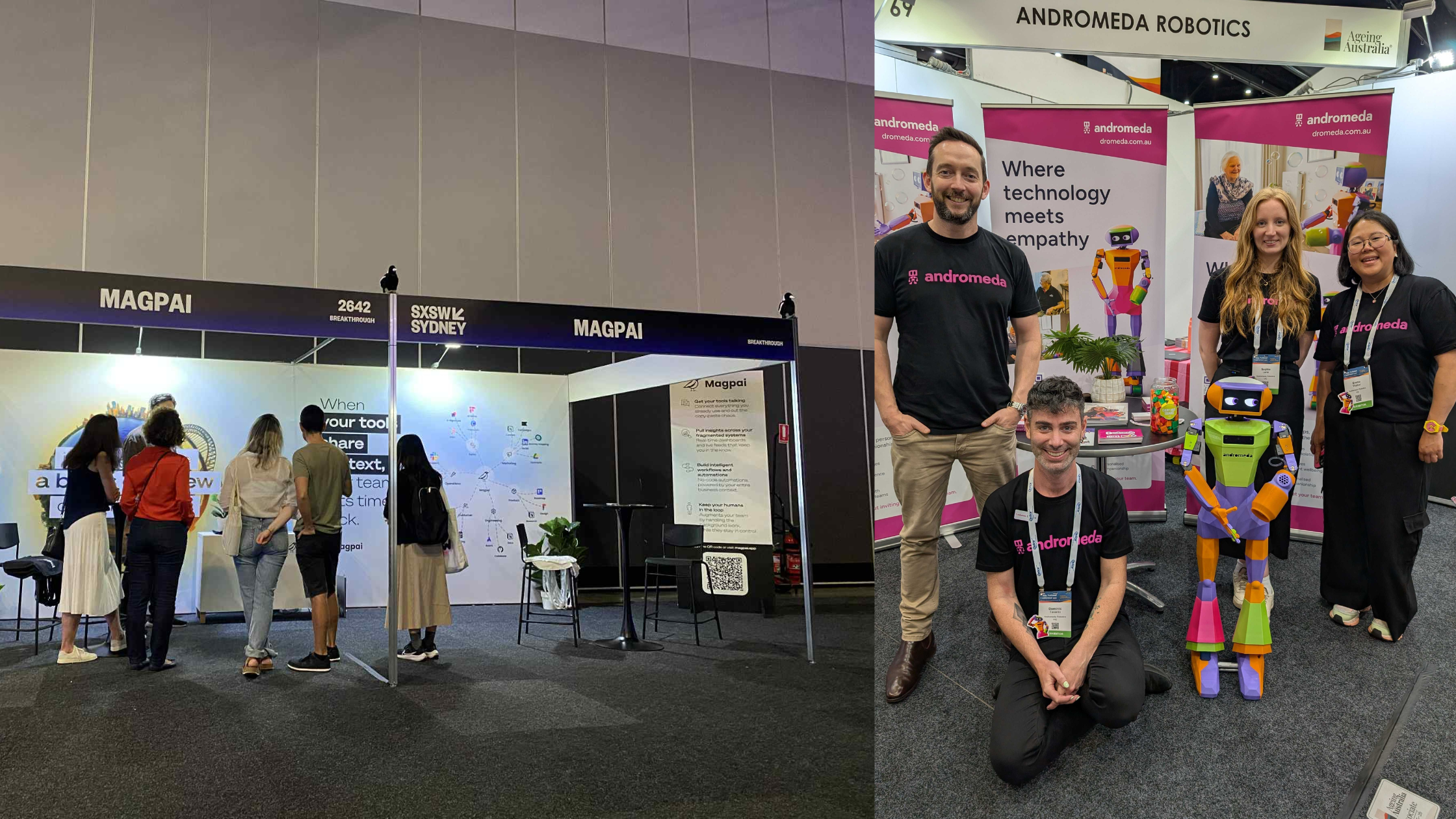
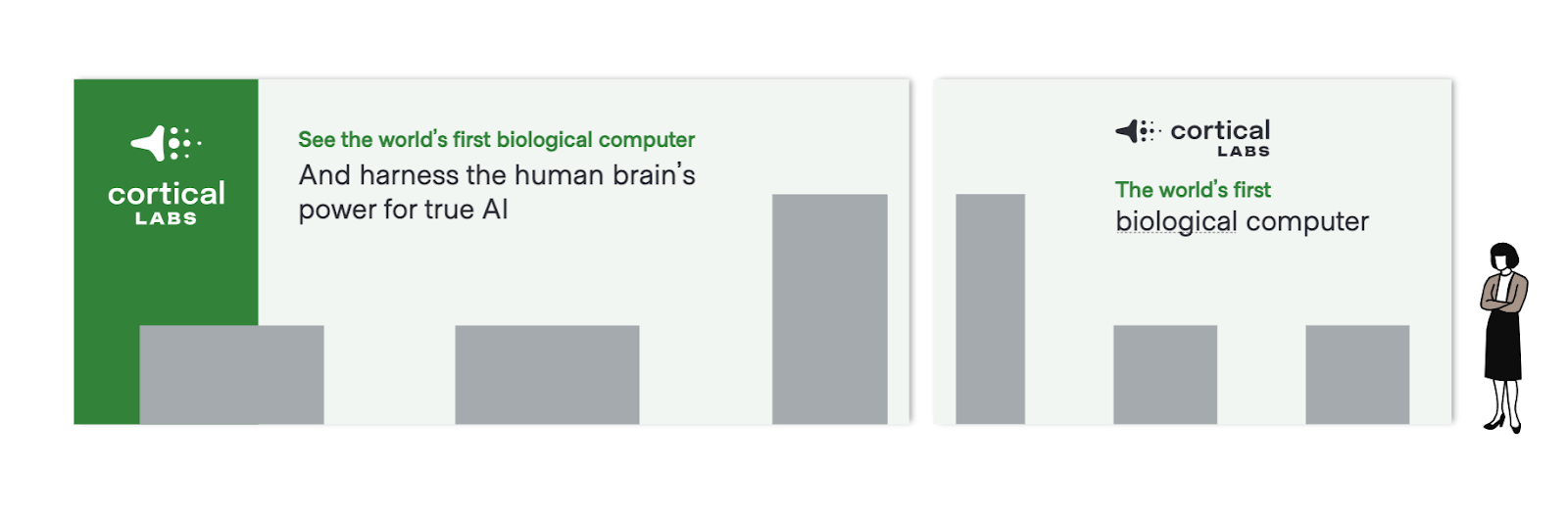
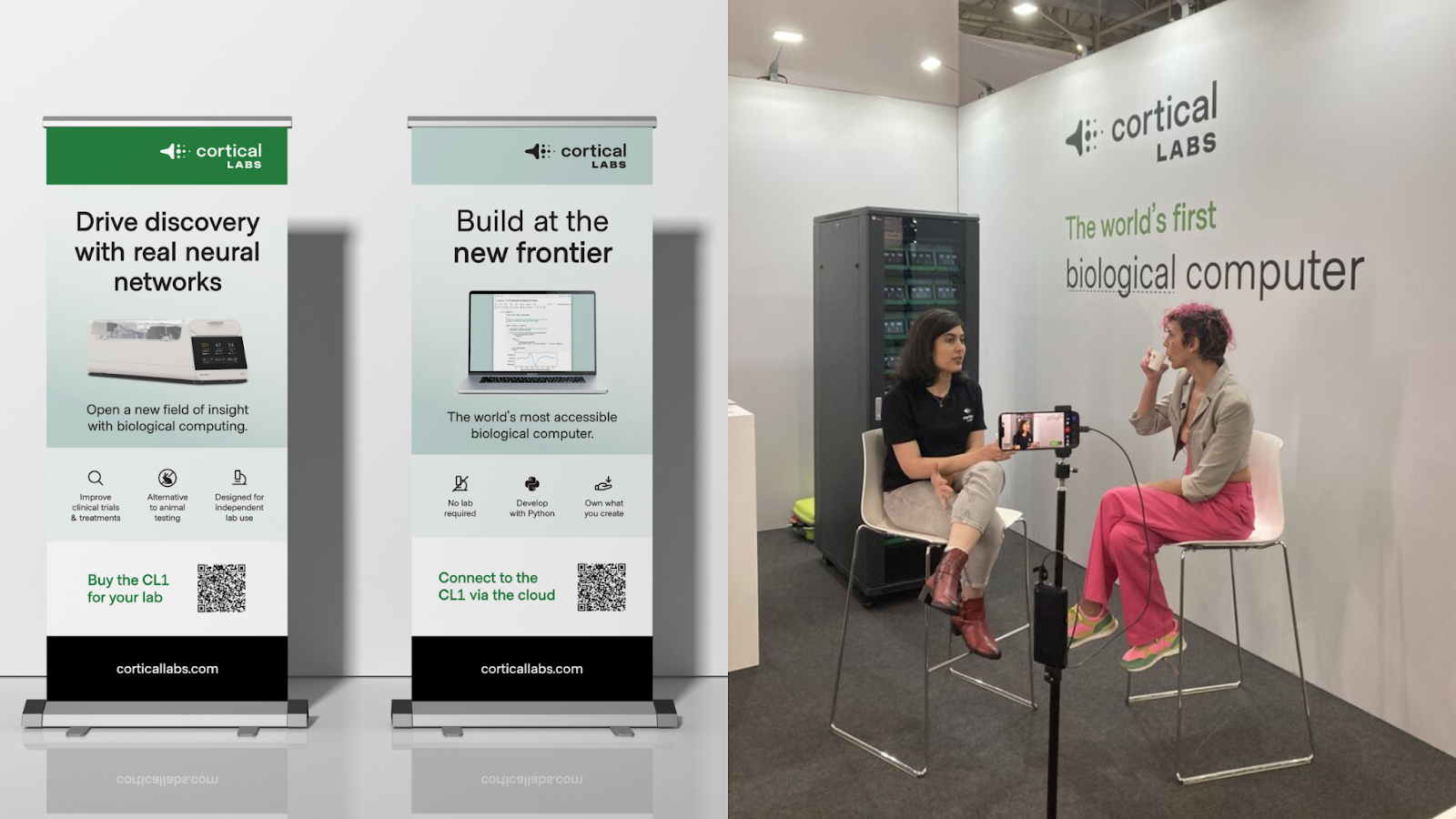
We've worked with clients preparing for all kinds of conferences: high-profile legal and compliance events (like when we created event signage for Haast's conferences in Australia and Las Vegas) to one of the world's biggest tech conferences, Mobile World Congress in Barcelona, where we helped Cortical Labs prepare designs for a large booth ahead of their official launch of the world's first commercially available biological computer.
Three hot tips:
- Designers are (usually) not writers. Decide what you want the collateral to say and then share that with your designer to make it work within the formats required. They might have suggestions for changing the copy to improve the design execution but they shouldn't be expected to write headlines and key messages.
- Make friends with your printer. Give them as much notice as possible about when to expect your designs ("artwork"), get clear on quotes early, and add 2-3 business days of buffer to any deadline they provide.
- Consider transport and installation logistics. Once your items are printed, who will pick them up/where will they be delivered? Have you allowed time for this? Who will be responsible for setting up the booth? Will you need to get there a day ahead of the event to set up? You get the idea!
4. Arm yourself with merch and collateral
A physical "takeaway" can be a powerful thing because it can:
- Give people something to help remember you once they leave
- Visually scatter your brand throughout the conference as people walk around with your merch (e.g. tote bags)
You can be much more creative than creating a one-page flyer - remember, your website should say what you need to convey. Business cards can be a good (simple and evergreen) option. A postcard-sized flyer with some key information about a specific time-bound offer (e.g. coupon or beta program) can be cost-effective and easy to spin up.
Creative idea examples:
- Andromeda's Abi Conversation Cards: We created a custom deck of conversation starter cards inspired by the way Andromeda's humanoid companion Abi sparks meaningful conversations and connections with aged care residents. These weren't just merch, they were a tangible demonstration of their product's value.
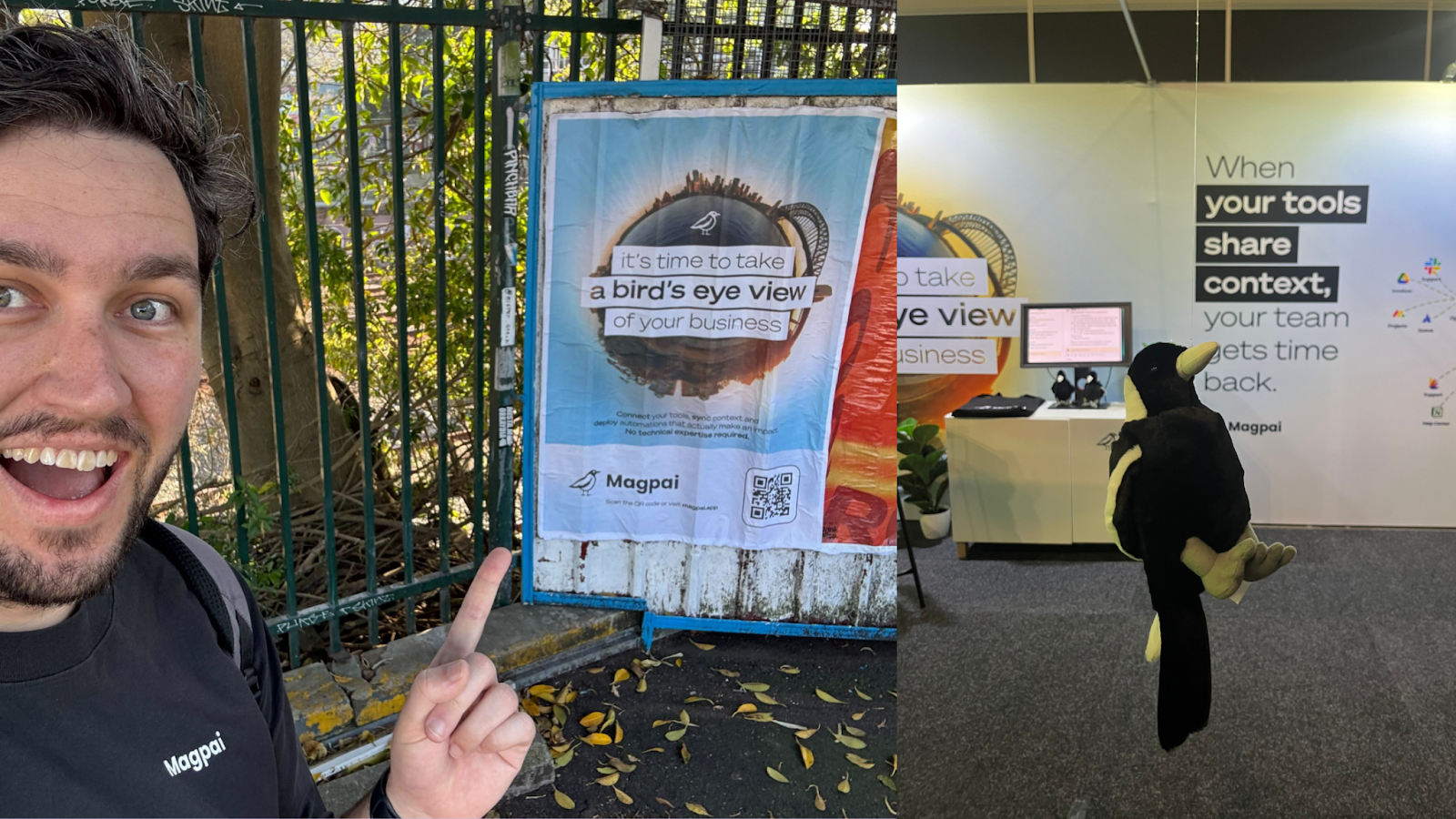
- Magpai's magpie plushies: Adorable, on-brand and highly memorable.
- Street-level marketing: Helping Magpai prepare for SXSW Sydney, we didn't just focus on their booth - we created street posters around the event location to build buzz and drive foot traffic.
5. Track, track, track
Remember when we all thought QR codes were dead? Well, COVID might have helped bring them back to life but conferences are really what's keeping them alive.
The worst possible outcome of spending potentially several days at a conference (and the opportunity cost of your time) is that you walk away with very little tangible value. For example: notes around conversation insights or contact details of customers and partners.
Decide ahead of time how you're going to capture the information or leads to hit your goals. Usually this will be a simple form to direct people to after speaking with you. Some conferences will provide their own software to help you scan attendees' badges/passes to capture their contact information.
It doesn't have to be fancy (in fact, sometimes simpler is better) but make sure you have a plan before rocking up. (This might affect how you approach your printed signage/collateral so think about it early!)
6. Follow up like your life (business) depends on it
When you wrap up the conference you'll probably want to lie down for a long time. You'll also likely have 5,000,000 emails and Slack messages to catch up on. But if you want to make sure all your efforts weren't for nothing, you have one final task: follow-ups.
This is another area we see startups neglect, and it's a huge lost opportunity.
The follow-up hierarchy
At a minimum, send an email to everyone you connected with. The smartest move is to set this up in advance so it's automatically triggered after the event. This ensures no leads fall through the cracks even when you're running on post-conference fumes.
For high-potential or high-value leads, go beyond the automated email. A personalised phone call is gold but a thoughtfully crafted individual email also works. Also connect with them on LinkedIn - it keeps you on their radar and makes future outreach feel more natural.
The crucial underlying framework
None of this matters if your CRM isn't set up to accurately ingest these leads and categorise them properly. Before the event, make sure your system is ready to handle the influx and your team know how to use it. This will enable successful post-event follow-ups.
Success metrics
Your follow-up metrics should align with your initial goals (remember Step 1?). Set your own benchmarks for post-event actions.
For example:
- If your goal was to speak to 20 ICP-aligned customers, track how many of those convert to discovery calls within two weeks.
- If you want to find 5 potential partners, measure how many move to the next stage of partnership discussions.
The key is to define what success looks like for your business, not to tick the "we sent follow-up emails" box.
Final words
As an early stage startup at a conference, it's likely no one will have heard of your business before. This is an advantage (you can use the novelty factor over businesses that attendees have seen time and time again), as well as an obvious disadvantage - you might not attract visitors as easily and you can easily be forgotten.
So, in addition to all the tips above, make sure you:
Use social proof - ideally logos of current customers that will be recognised by a majority of attendees. Seek permission from them to use their logos on your signage/collateral.
Have adequate people-power for your booth on all days of the conference. It's tiring work and if you attract a lot of people to your booth you want to be able to meet demand, or people will move on. Get at least 2-3 core team members and potentially even a customer who can speak to their experience.
Warm up your audience - let people know you'll be attending by reaching out directly in advance and using LinkedIn to let your broader audience know. (We did this for Magpai ahead of SXSW Sydney with a pre-event LinkedIn content campaign that built anticipation and drove booth traffic.)
A good place to start is by downloading our Brief Template & Checklist here.
Does this all feel very hard?
We’re not going to lie, preparing for a conference is no mean feat especially for a founder juggling many balls at once. That's where we come in.
Stella Startups can handle all these steps for you or work alongside you and your team to make sure deadlines are met and leads are captured. Whether you need help with event signage, merch, pre-event positioning or post-event follow-up planning, we've got you covered.
Get in touch to find out how we can set your marketing up for success – for conferences and beyond.
See related articles
.png)
In-house vs outsourced marketing: How to solve your needs at different stages


WTF is AEO and should startup founders care?


When (and how) should DeepTech startups invest in marketing?

Ready to make sense of marketing?